
Coal was one of the most important energy sources of the Industrial Revolution, powering steam engines, factories, and transportation. However, burning coal also created a lot of air pollution, which later became a serious problem. While coal helped economies expand, it also raised concerns about the environment. Looking back at its role in history helps us understand both the benefits and challenges of using fossil fuels as we explore cleaner energy options today.
What Role Did Coal Play in the Industrial Revolution?

The story of coal’s role in the Industrial Revolution begins in Coalbrookdale, a small village in England that’s often hailed as the cradle of industrialization. In 1709, Abraham Darby, an English ironmaster, revolutionized iron production by using a purified form of coal known as coke to smelt iron ore instead of using charcoal. This breakthrough made iron production more efficient, unlocking unprecedented scales of production, with Britain’s iron output soaring from 2,500 tons annually in the early 1700s to a staggering 2.5 million tons by 1850. Even if half of Britain was covered with forests solely to produce wood to turn into charcoal, using charcoal would have produced half as much iron per year. Iron, in turn, became the backbone of industrialization, enabling the construction of bridges, railways, and the machinery that powered cotton mills, steamships, and locomotives. Coal wasn’t just a fuel: It was the foundation of a new industrial age.
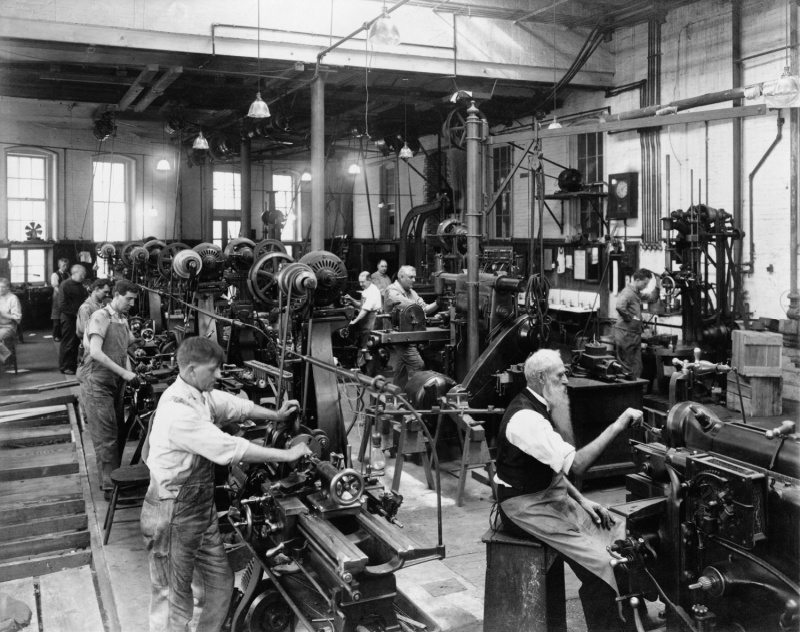
Beyond its role in making iron, coal became the lifeblood of industry by powering steam engines. Interestingly enough, the first steam engine, developed in 1712 by Thomas Newcomen, was designed to pump water out of coal mines, allowing deeper extraction and boosting coal supplies. A mechanical engineer named James Watt improved the steam engine in 1763, expanding its use across industries, and by 1870, steam power accounted for 90% of Britain’s industrial horsepower. To put this in perspective, 1 horsepower produced by a steam engine was equivalent to the work of 21 manual laborers, meaning that steam power effectively replaced the labor of 43 million workers.
Coal’s dominance as an energy source peaked in the 19th century, but its reign began to wane in the 1950s as oil and natural gas took over. By 2000, coal supplied just 19% of Britain’s energy, a stark decline from its industrial heyday.
Did Coal Play a Major Role in Economic Growth During the Industrial Revolution?
The role of coal in the Industrial Revolution is a hot topic among historians, with different views on just how essential it really was. Some history and economics experts argue that coal was the key to industrialization, providing cheap and abundant energy to power steam engines, fuel iron production, and drive economic expansion. They believe that without coal, the Industrial Revolution might have been severely limited by the availability of traditional energy sources like wood. However, not everyone agrees. Historian Joel Mokyr, a professor at Northwestern University, argues that innovation, institutions, and human creativity were the real forces behind economic transformation, not just coal. Adding another perspective, economics professors Gregory Clark and David Jacks performed an analysis based on the premise of an Industrial Revolution without coal and found that Britain’s economic growth may not have depended on coal as much as many believe.
But one of the strongest pieces of evidence in this debate comes from a 2020 study conducted by economists Alan Fernihough and Kevin O’Rourke, which examined the growth of 2,180 European cities over a period of 600 years. Their findings showed that before 1750, being close to sources of coal made little difference in urban development. However, after industrialization took off, cities near coalfields grew much faster than those farther away. This suggests that while coal wasn’t the only factor behind the Industrial Revolution, it became an essential resource once industrialization began.
Did Pollution Eventually Hinder Growth?

Coal pollution certainly had serious public health consequences during the Industrial Revolution. As early as 1661, writer John Evelyn warned about the dangers of coal smoke in his work Fumifugium. By the 1830s, activists were calling attention to poor living conditions in cities, where overcrowding, pollution, and filth were everyday problems. Research shows that by the 1850s, industrial coal use was responsible for about one-third of infant deaths in cities, illustrating just how deadly air pollution could be. Other studies have shown that children growing up in heavily polluted areas were physically affected, as seen in the shorter heights of soldiers born in these areas during the 1890s. This evidence makes it clear that coal pollution didn’t just damage the environment: It also harmed human health and development.
However, while it definitely affected physical growth, the effects of coal pollution on economic growth are less clear. Some historians argue that despite the dangers, people kept moving to cities, suggesting that pollution didn’t stop industrial expansion. But others, like Walker Hanlon, an economics associate professor at Northwestern University, argue that pollution actually slowed job growth in cities. Hanlon’s research supported the theory that the effects of pollution made cities less desirable places to live, reducing the number of available workers, and also hurt worker productivity, which lowered demand for labor.
Where Can I Find Out More?

- Why Was Coal So Important to the Industrial Revolution?
- The Industrial Revolution, Coal Mining, and the Felling Colliery Disaster
- Coal, Steam, and the Industrial Revolution
- Rise of Coal in the 19th-Century United States
- Coal Mines in the Industrial Revolution
- Fossil Fuels, Steam Power, and the Rise of Manufacturing
- Coal Mining in the British Industrial Revolution
- Coal Was Not Always the Path to a Modern Economy
- Coal and the European Industrial Revolution
- Charcoal-Fueled Kamado Grills
- Coal Demand and the Industrial Revolution
Who Are the Experts on This Question?